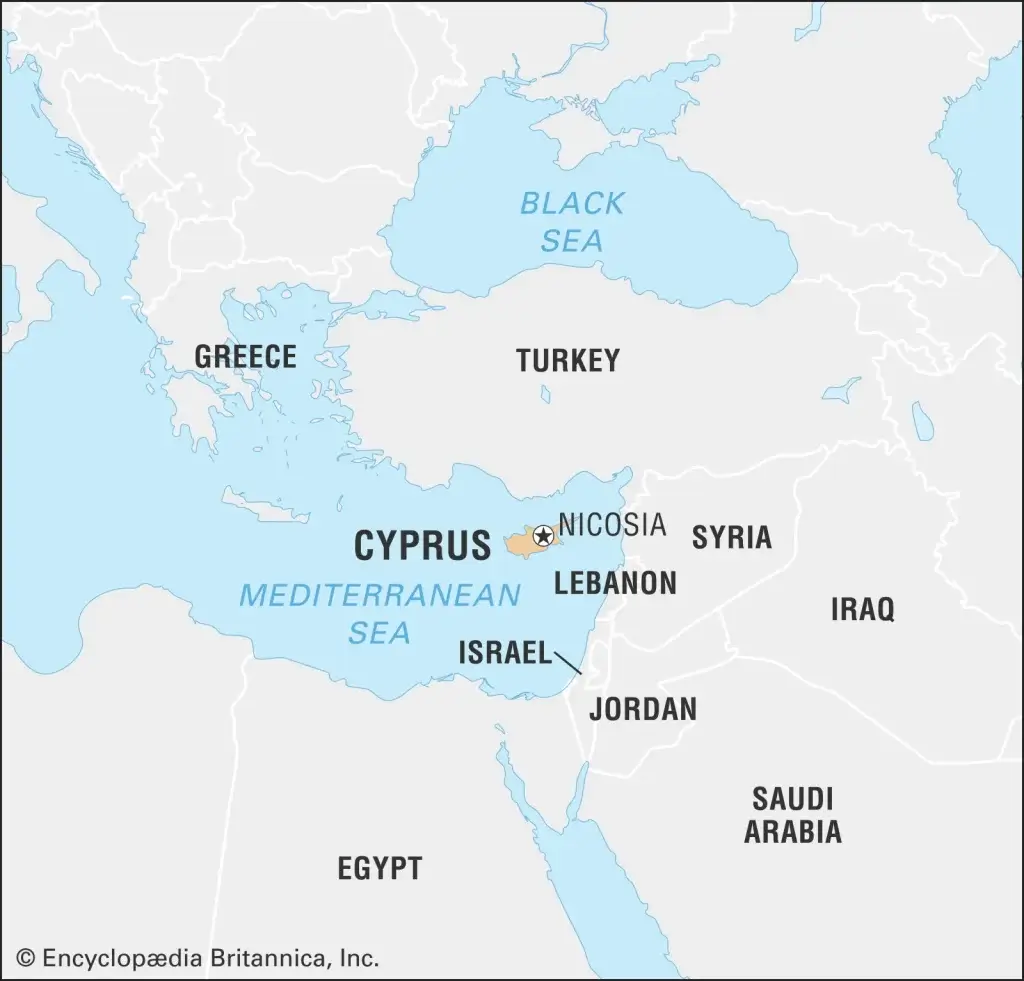
A Regional Map of Cyprus. Retrieved From: https://www.britannica.com/place/Cyprus
Global Conflict & Crisis Strategic Solutions (GC2S2)
Our Mission: To contribute meaningfully in conflict zones and during times of crisis.
About us: GC2S2 is an action-based think tank in Tysons, Virginia, USA, focusing on the Middle East and Africa. We concentrate on long-term strategic solutions to conflicts and crises in 3 ways: research and analysis to identify issues in countries we operate in, provide humanitarian aid through emergency & crisis services distributing supplies locals need, and capacity building by establishing long-term sustainable solutions. We are an apolitical organization and do not intervene or involve ourselves with any political entities or organizations.
Purpose: The purpose of the weekly report is to bring awareness to critical issues throughout the Middle East and Africa while also identifying ways in which we can address these concerns. We use these reports to identify future projects and strategic solutions for the problems raised. The weekly report is meant to be clear, concise, and inform readers while simultaneously providing unbiased perspectives and insights by addressing every issue pragmatically and holistically.
Projects: Currently, GC2S2 is developing two main projects focused on Syria and Lebanon. The Syria aid basket project is designed to provide 3,100 refugees a monthly supply of essential food and hygiene kits. The Lebanon project is designed around digital literacy and English courses to alleviate the lack of educational access in rural Lebanon.
Key Statistics
Population of Cyprus: 1,250,000 million people
Ethnic composition of Cyprus: 98.8% Greek Cypriot, 1% Turkish Cypriot, 0.2% Other
Established in 1964, the UN peacekeeping mission on Cyprus (UNFICYP) is the second-longest ongoing mission
There are 1,011 UN Peacekeepers on Cyprus as of 2018. The UN Peacekeepers are comprised mainly of Argentinian (362 personnel), the UK (275), and Slovakian (159) soldiers
UNFICYP has suffered 15 fatalities on Cyprus between 1964 to 2017 due to malicious acts
UNFICYP’s annual operational budget is $57,390,000
Nearly half of UNFICYP’s annual budget is provided by Greece and the Greek-supported government of the Republic of Cyprus
Background
The Republic of Cyprus was established in 1960 after a successful insurgency waged by the Greek Cypriot National Organization of Cypriot Fighters (EOKA) against the United Kingdom (UK). The EOKA waged this campaign for enosis, or unification with mainland Greece. Due to historically hostile Greek-Turkish relations, and the fact that Cyprus is located only 50 miles from the Turkish coast, enosis or even establishing a pro-Greek government on Cyprus presented an inherent threat to Turkey’s national security.
The Akritas Plan was enacted in 1963 to outlaw Turkish Cypriot participation in any level of government, causing intercommunal fighting between ethnic Greek and Turkish Cypriots. United Nations (UN) peacekeeping troops were deployed to the island in 1964 for the first time to establish law and order and to prevent the potential ethnic cleansing of Turkish Cypriots. The Turkish government voted to deploy forces to the island to support of the Turkish Cypriot population but ultimately withdrew due to condemnation from the UN and the North Atlantic Treaty Organization (NATO).
In July of 1974, Greece’s then-military junta government organized a coup in collaboration with the EOKA to overthrow the internationally recognized democratic government to annex the nation as its own. Turkey invaded Cyprus shortly after utilizing The Guarantee Treaty of 1960, allowing Greece, Turkey, or the UK to intervene in Cyprus to restore democracy unilaterally should a coup occur. Turkish troops rapidly gained control of nearly 40% of the island. UN peacekeeping forces established a buffer zone between the Turkish and Greek-controlled portions of the island and have remained there since. Turkey declared its territory as the Turkish Republic of Northern Cyprus (TRNC) in 1983, and to this day is the only country to recognize its independence officially.
Current Situation
The UN has been in months-long negotiations with the TRNC about constructing a road connecting the village of Pyla to the TRNC. Pyla is predominantly occupied by ethnically Turkish Cypriots and within the UN’s buffer zone. The completion of the road would circumnavigate UN checkpoints within the buffer zone and run through a portion of the Dhekelia military base, one of two active British military bases established on the island in the 1960s.
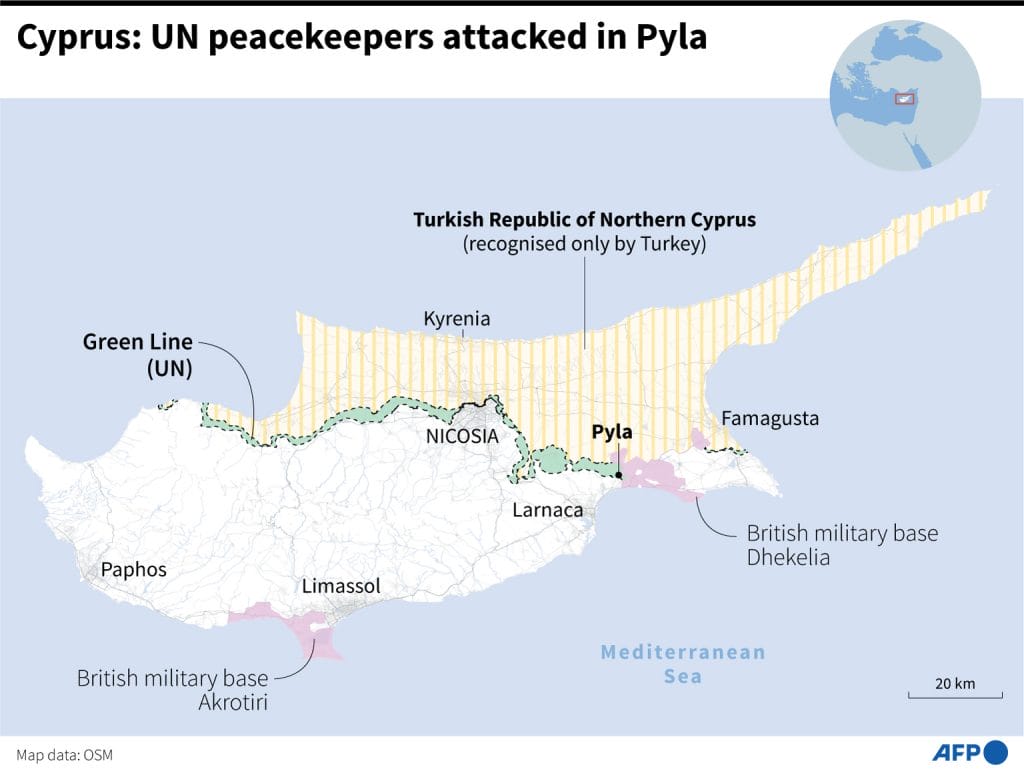
A Map of Cyprus Highlighting The UN Buffer Zone and The Village of Pyla Where The Attack On UN Personnel Took Place. Retreived From: https://www.barrons.com/news/cyprus-un-peacekeepers-attacked-in-pyla-82752239
However, in August of 2023, the TRNC began its “essential” road project without agreement from the UN. As the road construction has increasingly encroached on the buffer zone and British military base, tensions between the UN, the UK, the Republic of Cyprus, the TRNC, and Turkey have grown. The government of the Republic of Cyprus perceives the construction of the road to be for military purposes, facilitating TRNC movements in the event of a conflict. Construction of the road reached the buffer zone on the 18th of August, causing tensions to boil over in a spat of violence the island has not seen in more than a decade.
A small force of Slovakian UN peacekeeping soldiers and British soldiers from the nearby base confronted the much larger TRNC construction crew and their accompanying security forces. The Slovak and British soldiers linked arms and stood before construction crews attemptingto obstruct their progress. In response, the TRNC crew and security forces initiated a massive brawl that left three soldiers from the UN-British force hospitalized. The Turkish Cypriot crew also used bulldozers to clear out UN vehicles, bollards, concrete barriers, and barbed wire within the buffer zone.
In response to the event, the UN peacekeeping mission warned the TRNC that threatening UN peacekeepers, damaging UN property, and violating UN mandates constitutes serious crimes under international law that would be prosecuted to the fullest extent possible. The peacekeeping force also stated that it would continue to block and harass TRNC’s efforts to build the road non-violently. The US, France, and the UK, three of the five permanent members of the UN’s security council, condemned the attack perpetrated by the TRNC and called for both sides to peacefully resolve the ongoing issue. Aside from verbal condemnation and warnings of future obstructions, no actions have been taken against the TRNC.
The TRNC blamed the scuffle on the UN mission, calling their actions “unacceptable” and telling them to cease their efforts to obstruct a “humanitarian project.” Turkey’s President Erdogan sided with the TRNC, saying that Turkey would continue to support the TRNC and that it was neither “legal nor humane to prevent Turkish Cypriots living in Pyla from reaching their homeland.”
Prediction
It is highly likely that the current status quo of Cyprus will remain unchanged for the next 5-10 years. The internationally-recognized Republic of Cyprus and the Turkish-backed TRNC are firmly entrenched and supported ideologically and geostrategically. While both sides have willingly entered into negotiations with one another in the past, these discussions have not led to any high-level solutions nor compromises regarding the overall issue. Any similar efforts in the future are likely to yield the same results.
To solve the issue of allowing Turkish Cypriots access to the TRNC, both the TRNC and the Republic of Cyprus will likely reach an agreement to relocate the Turkish Cypriots from Pyla to the TRNC. Between when the TRNC was established in 1983 to 2023, both sides have agreed on similar operations several times to avoid escalating tensions. With aid from the international community, the Republic of Cyprus will likely subsidize the relocation operation to avoid unnecessary escalation and bloodshed.
It is improbable that the road connecting Pyla to the TRNC is completed in the near future as scheduled. UN peacekeeping forces and the British military are firmly entrenched along the road’s planned route, refusing the completion of the road. As a result, the construction of the road has the potential to develop into a flashpoint for future violence on Cyprus and throughout the region, pitting Turkey and the TRNC against essentially the world. Despite ample warnings from the UN, the continued construction of the road would only further alienate Turkey and the TRNC from the international community and is likely to be met with stiff resistance.
It is highly unlikely that Turkey will opt to escalate military actions on Cyprus in support of the TRNC and its construction project. NATO and the UN have strained relations with Turkey due to its increased diplomatic recognition of Syria’s Assad regime, human rights violations against the Kurdish, and its strengthening economic ties with Russia. Turkey’s security goals abroad in Libya, Syria, Iraq, and Somalia have been achieved primarily due to NATO support. Turkey also remains dependent on international aid to rebuild from the February 2023 earthquakes and keep its economy functioning amidst hyperinflation. It would be irrational for Turkey to risk future NATO support and membership as well as international socioeconomic support to fight for complete control of an island it already occupies half of and who’s legitimate government does not present an imminent threat.
Bibliography
Ap, et al. “Turkey Accuses Un of Losing Its Neutrality in Cyprus Road Spat.” The Times of Israel, 22 Aug. 2023, www.timesofisrael.com/turkey-accuses-un-of-losing-its-neutrality-in-cyprus-road-spat/.
“Contributions by Country Peacekeeping.” United Nations, United Nations, peacekeeping.un.org/en/contributions-country.
Guterres Condemns Assault against UN Peacekeepers in Cyprus | UN News, news.un.org/en/story/2023/08/1139912
“Turkey Says UN Peacekeepers Intervention of Turkish Cypriot Roadworks Unacceptable.” Reuters, Thomson Reuters, 21 Aug. 2023, www.reuters.com/world/middle-east/turkey-says-un-peacekeepers-intervention-turkish-cypriot-roadworks-unacceptable-2023-08-21/.
“U.N. Calls Unauthorized Construction by Turkish Cypriots a Violation of the Status Quo on Cyprus.” AP News, AP News, 22 Aug. 2023, apnews.com/article/turkey-cyprus-un-peacekeepers-erdogan-de766e37a742f6ecb51752ec7b6f9619.
“UN Peacekeepers Hurt in Cyprus Buffer Zone Clash with Turkish Forces.” Reuters, Thomson Reuters, 18 Aug. 2023, www.reuters.com/world/un-peacekeepers-hurt-cyprus-buffer-zone-clash-with-turkish-forces-2023-08-18/.
“UNFICYP Peacekeeping.” United Nations, United Nations, peacekeeping.un.org/en/mission/unficyp.