Current Projects: GC2S2 is developing a significant health and nutrition project for the Kampala, Uganda region. Our objectives are 1) focusing on establishing health clinics with traveling nurses and doctors to address the lack of access to medical care in rural or slum areas, 2) developing a nutrition plan for educational institutions for young students (children), and 3) providing family planning services and feminine hygiene products to women and young girls to assist with keeping young women in school, in addition to ensuring mothers have access to the care needed both pre and postpartum.
Written by Meaghan Mackey
Background
On April 15, 2023, fighting broke out in Sudan between the country’s Sudanese Armed Forces (SAF) and the rebel paramilitary organization, the Rapid Support Forces (RSF). The RSF militia comprises the Janjaweed militias, which fought on behalf of the Sudanese government, specifically in the Darfur region.
The Janjaweed militias played a significant role in helping the Sudanese government in the 2003 to 2020 Darfur conflicts. This civil war in Sudan came at a time when the country was already struggling with a humanitarian crisis, and this new conflict has only made conditions worse.

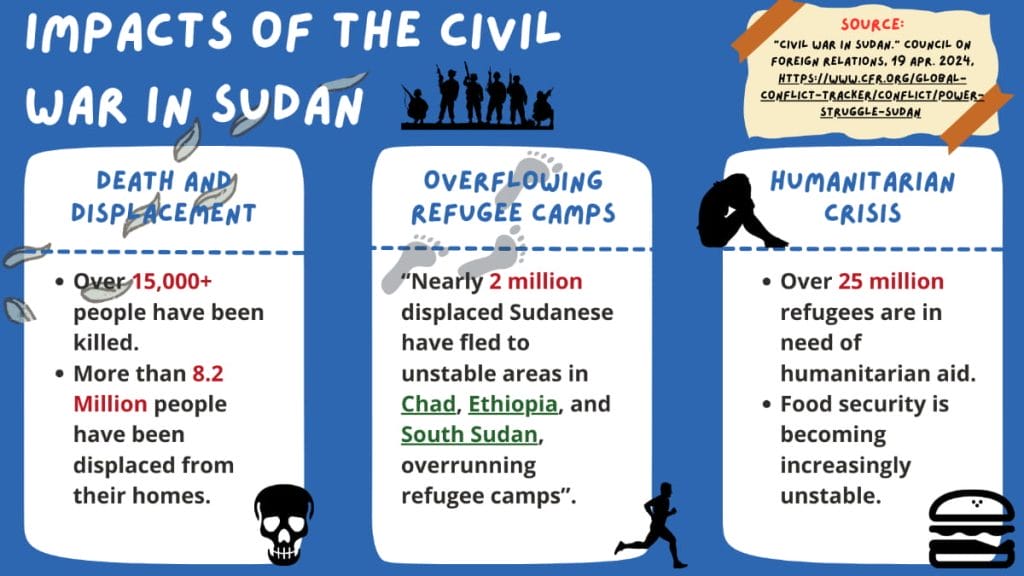
The majority of the fighting has taken place in the country’s capital city, Khartoum, with other regions, such as the Darfur region, being affected by increasing instances of ethnically charged violence. As a result, 15,000 people have been killed, with 8.2 million people having been displaced from their homes. This mass displacement in Sudan has severely affected Sudan’s neighboring countries, with refugees fleeing to Chad, Ethiopia, South Sudan, and Egypt.
Since the start of the conflict, international actors have increasingly tried to step in to push the SAF and the RSF to peace negotiations. In May 2023, the US and Saudi Arabia attempted to mediate peace negotiations, which ultimately collapsed due to SAF’s unwillingness to continue. Following this peace attempt, the US and Saudi Arabia have attempted unsuccessfully to get both warring parties to agree to a ceasefire.
The Current Situation
Since the start of the conflict over a year ago, Sudan’s humanitarian crisis has been escalating, with the increased violence and mass displacement being the leading causes for the deterioration of conditions.
The country’s infrastructure, specifically its health care system, is struggling to keep up with heightened demand and diminishing resources. Many hospitals and healthcare centers have closed due to the fighting, leaving the few remaining facilities to deal with the increased demand.
https://unsplash.com/photos/people-in-white-robe-sitting-on-brown-concrete-bench-during-daytime-uj9jnMnaaUw
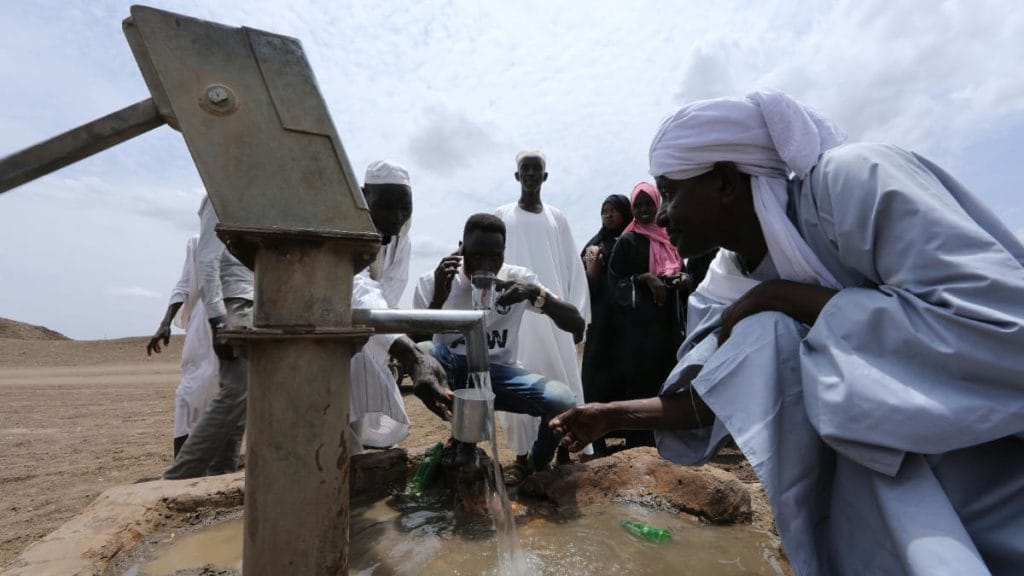
In addition to healthcare, other critical infrastructure in Sudan has also been heavily affected by the fighting and displacement rates, including water, sanitation, and hygiene services.
Reduced quantity and quality of water have left civilians more susceptible to disease and have resulted in outbreaks of measles and cholera throughout the country, which has also contributed to the increased death rates.
Sudan is also facing high rates of food insecurity due to the conflict, which will likely worsen as fighting continues to spread into the country’s Al Jazirah state. Since December 2023, fighting between the SAF and the RSF has moved into Al Jazirah which, prior to the conflict, was responsible for many essential agricultural industries that produced a majority of the country’s wheat and grain needs.
The RSF has been able to capture many critical towns in the region and has stationed military assets close to essential agricultural fields while the SAF has been conducting air strikes and ground operations to re-take land, with some operations specifically targeting critical infrastructure such as bridges and food supplies.
This heavy fighting has resulted in the destruction of many fields and crops with the RSF being accused of looting any harvest that was able to survive.
The decreased agricultural capabilities in the Al Jazirah state will very likely affect other regions throughout Sudan, likely further exacerbating the already intense food crisis. Mass internal civilian displacement is another factor that will add to the increasing food crisis, with regions having to extend their resources to accommodate the influx of refugees.
Solutions
Short-term and Long-term – Humanitarian Aid
For short-term aid, GC2S2 could significantly combat the food insecurity crisis by distributing food to refugee camps throughout the region. Distributing food packages for families can help combat malnutrition and ensure refugees get the necessary nutrition they need to survive.
To help create a long-term solution to the problem, GC2S2 could also help foster long-term agricultural sustainability in refugee camps by providing the necessary supplies and education to implement these practices. This would allow refugees to become self-reliant and decrease the ongoing food crisis among the Sudanese.
Short-term and Long-term – Water Security
In addition to providing food and agriculture-related aid, GC2S2 could also provide clean water to displaced Sudanese living in refugee camps in neighboring countries. Distributing clean water would significantly help combat the influx of diseases that are being seen in densely populated areas.
Furthermore, GC2S2 can provide long-term water security strategies by providing refugees with educational lectures on collecting and purifying water to increase future self-reliance, such as collecting rainwater and boiling that water to purify it. Purification tablets can also be distributed to the communities to help ensure that these refugees will have the necessary resources to drink clean water in the future.
Long-term – Health Care Services and Infrastructure
Although clean water and agriculture are both exceedingly important solutions in terms of humanitarian aid, providing long-term healthcare solutions for Sudanese residents has the potential to have the most significant impact on the war-torn population.
GC2S2 could assist in building a foundational structure for healthcare by distributing critical healthcare supplies and setting up accessible clinics for Sudanese civilians. These clinics would provide Sudanese civilians with the necessary care they need to survive and thrive throughout the region.
Even basic medical supplies like everyday medicines and first aid kits could make a massive difference for thousands of injured civilians; these supplies could be distributed to refugee camps and pop-up clinics to help combat the increasing spread of diseases and injuries among the population. Additionally, surgical medical supplies can also be focused on, to provide for the heightened need to care for more serious injuries.
Thank you for reading and being part of the GC2S2 community! Stay connected with us and be the first to know about our latest initiatives by following us on Instagram, Twitter, and Facebook. Join us in our mission to make a difference and create lasting change; together, we can create a better future for everyone!
Bibliography
“Civil War in Sudan.” Council on Foreign Relations, 19 Apr. 2024, https://www.cfr.org/global-conflict-tracker/conflict/power-struggle-sudan
“Crisis in Sudan: What is happening and how to help.” International Rescue Committee, 12 Apr. 2024, https://www.rescue.org/article/fighting-sudan-what-you-need-know-about-crisis#:~:text=War%20continues%20to%20rage%20in,other%20regions%20of%20the%20country.
“Sudan Crisis Explained.” The UN Refugee Agency, 15 Apr. 2024, https://www.unrefugees.org/news/sudan-crisis-explained/
“Who is fighting in Sudan?” Reuters, 15 Apr. 2024, https://www.reuters.com/world/africa/who-are-sudans-rapid-support-forces-2023-04-13/