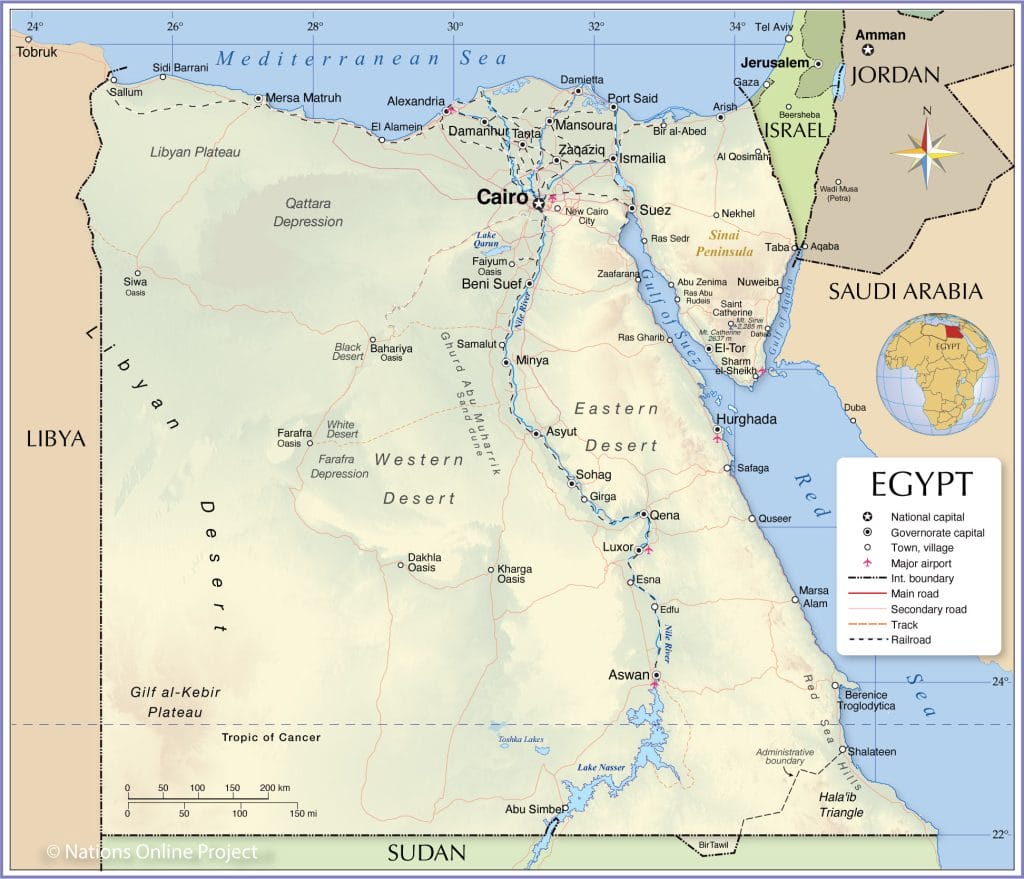
A Map of Egypt. Retrieved From: https://www.nationsonline.org/oneworld/map/egypt_map.htm
Global Conflict & Crisis Strategic Solutions (GC2S2)
Our Mission: To contribute meaningfully in conflict zones and during times of crisis.
About us: GC2S2 is an action-based think tank in Tysons, Virginia, USA, focusing on the Middle East and Africa. We concentrate on long-term strategic solutions to conflicts and crises in 3 ways: research and analysis to identify issues in countries we operate in, provide humanitarian aid through emergency & crisis services distributing supplies locals need, and capacity building by establishing long-term sustainable solutions.
We are an apolitical organization and do not intervene or involve ourselves with any political entities or organizations.
Purpose: The purpose of the weekly report is to bring awareness to critical issues throughout the Middle East and Africa while also identifying ways in which we can address these concerns. We use these reports to identify future projects and strategic solutions for the problems raised. The weekly report is meant to be clear, concise, and inform readers while simultaneously providing unbiased perspectives and insights by addressing every issue pragmatically and holistically.
Projects: Currently, GC2S2 is developing two main projects focused on Syria and Lebanon. The Syria aid basket project is designed to provide 3,100 refugees a monthly supply of essential food and hygiene kits. The Lebanon project is designed around digital literacy and English courses to alleviate the lack of educational access in rural Lebanon.
Key Statistics
Egypt is the third largest country in Africa in terms of population with 112 million people.
There have been two military coups in the nation’s modern history, the Officer’s Rebellion of 1952 and the 2011 Arab Spring.
The military has been semi-autonomous politically and socio-economically since 1952, frequently funding itself and operating without government directive.
During the 2011 Egyptian Arab Spring security forces killed 846 and injured more than 6,000 protestors.
There are 65,000+ Egyptian political prisoners in 2023, including at least 2,578 women and children.
In 2022 Egypt was the 50th most corrupt country of 180 ranked by Transparency International, receiving a score of 30/100.
Egypt is “not free” in 2023 according to Freedom House, receiving a score of 6/40 for political rights and 12/60 for civil liberties.
Background
Egypt’s political system has frequently been referred to as the “Officer’s Republic” because of the military’s heavy presence in both the political and economic spheres. The nation’s political leaders have historically empowered security forces’ authority in these sectors to appease senior-ranking officers via increased social status, salaries, and fringe benefits in an effort to prevent coups. Additionally, the public has ceded some of its freedoms to the government in order to receive increased socio-economic benefits.
The 2011 Egyptian Arab Spring protests were the result of years of societal frustration over government corruption, media censorship, security forces’ abuses, high unemployment, and inflation. However, the events that transpired were ultimately sparked by the announcement of an end to government bread subsidies. More than 21 million citizens living in poverty could no longer afford basic food necessities. In response to the Arab Spring, Mohamed Morsi was the first democratically elected president in Egypt’s history. Morsi, and democracy, lasted 368 days before being deposed and undone by a military coup led by current president Abdel Fattah El-Sisi.
Current Conditions
Similar socio-economic indicators to those of 2011 have Egypt poised for a new Arab Spring in 2023. Since coming to power, President Sisi has replaced, bought, or blackmailed opposition judges and members of parliament to effectively eliminate judicial and legislative checks on his power. He has since amended the constitution to extend presidential term limits from four to six years and has granted himself a third consecutive term that will last until 2030. However, because the government is in essence a military junta, it is highly unlikely that Sisi cedes power following his third term. Furthermore, vaguely-worded amendments to the constitution under Sisi have empowered security forces with unprecedented economic freedoms. From President Sisi’s perspective, the nations’ security forces have been entrusted to correct the socio-economic failures of civilian institutions in order to prevent another military coup.
Current estimates posit that anywhere from 25-40% of all public infrastructure is owned and managed by security forces. The military and intelligence services have gained control of “vital national security sectors” such as energy and mass-infrastructure construction, as well as more minor sectors such as real estate and manufacturing. Even “private” corporations and businesses have direct ties to the nation’s military and intelligence services. The government’s Central Auditing Organization, Egypt’s Internal Revenue Service, has been ordered by President Sisi to ignore the security forces’ business dealings. President Sisi’s actions have purposely limited transparency and drastically increased embezzlement.
Many of the nation’s independent media outlets have recently been muzzled by censorship laws and intimidation tactics on behalf of the government. The vast majority of outlets operating today are vehemently pro-Sisi. Frequently, state and security forces’ media outlets limit the population’s access to credible information by peddling disinformation and propaganda to promote animosity against political opposition to President Sisi. Even independent and foreign journalists often face dangers from the state. The government was responsible for the killing, imprisonment, and disappearance of 34 journalists in 2022.
Despite being one of the major causes for the Egyptian Arab Spring, security forces continue to abuse the population with impunity to this day. The government passed purposefully vague counterterrorism laws in 2015 in response to the assassination of the nation’s chief prosecutor and Sisi loyalist, Hisham Barakat. These laws provided security forces sweeping powers and immunity in enforcing them. Between 2015-2020, security forces carried out more than 755 extrajudicial executions against alleged terrorists as a result of these laws. The government and its security forces stated that many of these deaths were the result of “shoot-outs” with members of terrorist organizations. Security forces have also been known to frequently kidnap, torture, and kill political opposition. In some cases, security forces claimed that these political opponents had ties to terrorist organizations and died resisting arrest.
The nation’s 10.5% unemployment rate has continued to negatively impact its population. A job-specific university education system has severely limited labor mobility amongst the youth. In recent years, many graduates have had to emigrate to other countries to find ample employment opportunities in their respective fields. Because the economy is dominated by security forces there are few industrial and labor intensive jobs available to the public. Some estimates suggest as much as 60% of the population now lives in poverty. Between January and June of 2023, the Egyptian pound has depreciated nearly 50% against the U.S. dollar. Due to an acute shortage of foreign currencies, backlogs of goods at ports have begun to develop as the nation struggles to trade within the global economy.
The ensuing economic crisis has only been exacerbated by the ongoing Russia-Ukraine War. Following the Arab Spring, the government strived to prioritize domestic grain production and heavily subsidized the agricultural sector. Despite these efforts, the country still imports more wheat than any other in the world, importing 12.8 million tons annually. Before the war began, Russian and Ukrainian-sourced grains accounted for more than 90% of Egypt’s total imported grain. Since the outbreak of the conflict, Egypt’s reliance on Russian grain has risen from 50% to 57%, while Ukrainian grain has dropped from 37% to 9%. The lack of foreign currency has made it difficult for the government to diversify its grain imports, leading to price increases in response to the national shortage.
The International Monetary Fund (IMF) and the World Bank Group (WBG) have financed the government on the condition that the state reduce its footprint in the domestic economy and rectify the nation’s position in the global economy. However, the Sisi government has repeatedly ignored the recommendations of its international financial supporters. Instead, the government has used international financial aid to service its debt, which now consumes 45% of its annual revenue. The influx of foreign currencies is also frequently used to offer new contracts to the nation’s security forces. These contracts are typically for ambitious mega-projects, like the $58 billion construction of New Cairo, that only temporarily alleviate some of the economy’s issues. Finally, Egypt remains the third-largest weapons importer in the world despite its unstable economy and a lack of a serious imminent threat to national security.
Essentially, the government is misusing its foreign currency reserves by financing domestic projects and programs against the advice of the IMF and WBG. President Sisi is willingly disregarding and worsening underlying socio-economic issues in an effort to postpone an anticipated crisis. However, to ensure stability he must constantly appease both the military and civilian populations. If the political and socio-economic issues are not consistently addressed, Egypt is at risk of experiencing a new Arab Spring.
Solutions
Government sanctioned violence against political diversity within Egypt prevents GC2S2 from providing some levels of socio-political assistance on the ground. However, GC2S2 can still make a significant impact by conducting awareness campaigns that focus on exposing corruption, censorship, and human rights abuses by the government. GC2S2 aims to mobilize support, foster solidarity, and exert pressure on appropriate international actors to address these issues and hold the responsible parties accountable.
Economically, GC2S2 can offer Egypt’s population courses and workshops focused on digital literacy, English, agriculture, and business entrepreneurship. By doing so, GC2S2 will not only bolster two of the nation’s premiere economic sectors but will also teach the population useful skills that will increase future job mobility and mitigate brain drain.
Lastly, GC2S2 can collaborate with local partners and international relief organizations to provide humanitarian aid to those who need it most. Providing basic necessities such as food, clean water, medical supplies, hygiene products, and shelter will greatly help to alleviate the burden that many Egyptians are facing amidst the nation’s economic crisis.
Bibliography
“Arab Spring in Egypt, The.” Religion and Public Life at Harvard Divinity School, rpl.hds.harvard.edu/faq/arab-spring-egypt.
“Egypt Country Risk Report.” GAN Integrity, ganintegrity.com/country-profiles/egypt/.
“Egypt Security Forces Accused of Covering up Extrajudicial Executions.” BBC News, 7 Sept. 2021, www.bbc.com/news/world-middle-east-58475287.
“Egypt.” Transparency.Org, www.transparency.org/en/countries/egypt.
“Egypt: Freedom in the World 2023 Country Report.” Freedom House, freedomhouse.org/country/egypt/freedom-world/2023.
“Egypt’s Headline Inflation Surges to 25.8% in January.” Reuters, 9 Feb. 2023, www.reuters.com/world/africa/egypts-headline-inflation-increased-258-january-capmas-2023-02-09/.
Egypt’s Military Now Controls Much of Its Economy. Is This Wise?, carnegie-mec.org/2019/11/25/egypt-s-military-now-controls-much-of-its-economy.-is-this-wise-pub-80281.
“How Deep Are Egypt’s Economic Troubles?” Reuters, 3 Mar. 2023, www.reuters.com/world/middle-east/how-deep-are-egypts-economic-troubles-2023-03-03/.
Labor Market Pressures in Egypt: Why Is the Unemployment Rate Stubbornly High?, arab-api.org/Files/Publications/PDF/649/649_j10-2-5.pdf.
Reports, Special. “Under Sisi, Firms Owned by Egypt’s Military Have Flourished.” Reuters, 16 May 2018, www.reuters.com/investigates/special-report/egypt-economy-military/.
“World Report 2021: Rights Trends in Egypt.” Human Rights Watch, 13 Jan. 2021, www.hrw.org/world-report/2021/country-chapters/egypt.
“‘Prison Atlas’ Details Egyptian Cases, Prisoners, and Judges.” Human Rights First, 6 Jan. 2023, humanrightsfirst.org/library/prison-atlas-details-egyptian-cases-prisoners-and-judges/.