Global Conflict & Crisis Strategic Solutions (GC2S2)
Our Mission: To contribute meaningfully in conflict zones and during times of crisis.
About us: GC2S2 is an action-based think tank in Tysons, Virginia, USA, focusing on the Middle East and Africa. We concentrate on long-term strategic solutions to conflicts and crises in 3 ways: research and analysis to identify issues in countries we operate in, providing humanitarian aid through emergency & crisis services, distributing supplies locals need, and capacity building by establishing long-term sustainable solutions.
We are an apolitical organization and do not intervene or involve ourselves with any political entities or organizations.
Purpose: The weekly report aims to bring awareness to critical issues throughout the Middle East and Africa while identifying ways to address these concerns. We use these reports to identify future projects and strategic solutions for the problems raised. The weekly report is meant to be clear, concise, and inform readers while simultaneously providing unbiased perspectives and insights by addressing every issue pragmatically and holistically.
Projects: Currently, GC2S2 is developing two main projects focused on Syria and Lebanon. The Syria aid basket project is designed to provide 3,100 refugees with a monthly supply of essential food and hygiene kits. The Lebanon project is designed around digital literacy and English courses to alleviate rural Lebanon’s lack of educational access.
Lake Chad Fact Sheet:

Surrounded by sand dunes and semi-arid land, Lake Chad is an oasis in an otherwise barren land. It is the lifeline for over 46 million people, all of whom rely on the lake for their livelihoods and most basic necessities. However, Lake Chad has drastically shrunk in the last 60 years, ushering in instability, mass poverty, and food insecurity. These poor conditions have opened the door for the terrorist groups Boko Haram and the Islamic State-West Africa Province (ISWAP) to grow in size and influence. Both groups have trapped the region in a vicious cycle of violence and destitution, resulting in millions fleeing for fear for their lives—those who remain either join these groups or live in fear and violence.
Droughts, over-consumption, and poor damming practices have resulted in the lake losing over 90 percent of its water volume, decreasing the area of the lake from 25,000 km2 to less than 2,000 km2.1 Although the lake has an extensive history of changing water levels, the severe droughts of the 1970s and 80s have caused irreparable damage. During these years, the rainfall decreased from 436mm a month in 1964 to 238mm in 1983, causing the water to lose a third of its depth.2

https://cdn2.hubspot.net/hubfs/1131952/Imported_Blog_Media/1-40720892.jpg
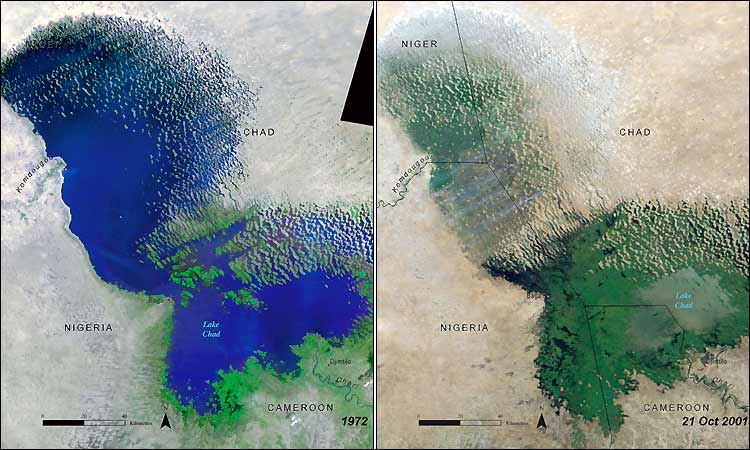
Lake Chad has never experienced another decrease of the same magnitude. However, it has yet to recover, and its water levels always remain susceptible to changes in weather. Additionally, the area’s massive population boom and irresponsible damming practices have compounded the effects of droughts and hindered replenishment strategies. The population dependent on Lake Chad has nearly quadrupled since the 1960s, growing from 13 million to 46 million by 2015.3 It continues to grow at a constant rate, and with it, so does water consumption. While the people’s use of irrigation depletes the lake’s resources, irresponsible damming practices by the neighboring countries have reduced the lake’s inflow. Nigeria, Niger, and Chad have used dams to divert the lake’s source rivers for energy and other projects in their own territory. While the international community has partially addressed these damming practices, some dams remain and are major contributors to the lake’s reduction.4
The region has failed to diversify its economy and continues to focus on industries that rely on the lake, such as farming, fishing, and herding. Additionally, the reduction in resources and viable land has led to a complete lack of opportunities for employment. In some areas, over half of the population between 15 and 39 years old is unemployed.5 Workers are left with two options; migrate or compete for resources. Both options have caused increased tensions and instability amongst the basin communities, often resulting in conflict.6 The poor economic conditions and regional instability leave the lake’s inhabitants susceptible to terrorist groups, who exploit the crisis to increase recruitment and operations. These groups often offer the people a way out of their current situation, enticing them with money, shelter, and employment in exchange for their loyalty and service. Many locals agree to the terms, and a vicious cycle ensues.
https://defensenigeria.wordpress.com/2017/11/12/in-photos-on-the-banks-of-despair-with-lake-chads-boko-haram-refugees/
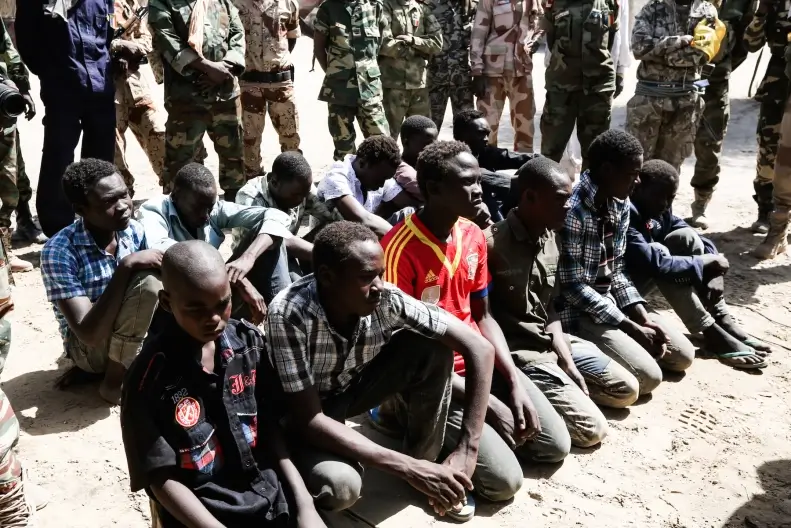
Terrorists wreak havoc on the basin communities, killing innocents, disrupting trade, and increasing conflict intensity. In the past decade, Boko Haram and ISWAP have killed over 30,000 locals.7 The violence has caused millions of people to flee their homes for fear of their lives, and over 2.9 million people remain internally displaced in the region.8 In addition, terrorist activity also heavily contributes to the region’s extreme food and water insecurity. These groups destroy crops, attack farmers, and burn farmland, causing food prices to surge and production to stall. Reports show that Boko Haram has destroyed over 988 acres (400 hectares) of wheat annually since 2016.9 Currently, food insecurity is at record highs, with over 5.6 million inhabitants unable to access food and going entire days without eating. Children are the most vulnerable to the food crisis, with over 300,000 enduring life-threatening malnutrition.10
Solutions:
Establishing a permanent security force would aid in countering the terrorist threat but would require international intervention and cooperation from neighboring nations and lake communities. The local communities and national governments would have to work to establish a regional partnership. The communities of Lake Chad, like many African regions, do not exhibit a sense of strong national identity. Instead, the political structure revolves around tribes and ethnic groups, making national initiatives difficult to implement.
However, governments can conduct projects in the region to increase the quality of life. Projects such as building power plants, water distribution networks, and highways would aid in building national pride and attract private sector investment. Increasing industry and infrastructure would instill a sense of security among the people and decrease terrorist influence over the region. These plans require significant time and resources to come to fruition. Therefore it is essential that action is taken immediately to mitigate this growing issue.
While damming practices have contributed to decreasing water levels, they might provide an innovative solution. Nigeria is currently working on a project to build a series of dams and canals in the Democratic Republic of the Congo and the Central African Republic. The project known as Transaqua would cause water from the Congo River to flow to the Chari and subsequently to Lake Chad. It is estimated that this series of canals and dams would significantly increase the flow into the lake. However, the project, which was first conceptualized in 1993, has yet to begin.11
While the neighboring nations and international community work to replenish the lake and counter the terrorist threats, GC2S2 can dispatch humanitarian aid directly to the lake communities. By delivering packages containing rations and supplies, GC2S2 can help alleviate food insecurity while improving the living conditions of the inhabitants. In addition, GC2S2 can start a media campaign to raise awareness of the crisis and collect donations from the global community. Donations would be used to mitigate food insecurity and provide guidance and support for the internally displaced population. GC2S2 would couple these short-term solutions with a long-term strategy centered around educating and training the population on more advanced and efficient farming and fishing practices. Doing so would allow these communities to continue practicing their trades while making better use of the scarce resources.
Endnotes:
- “The Rise and Fall of Africa’s Great Lake.” Earth Observatory. NASA (11/09/2017). https://earthobservatory.nasa.gov/features/LakeChad#:~:text=Lake%20Chad%20sits%20within%20the,is%20bordered%20by%20mountain%20ranges.
- Ibid.
- “Boko Haram: Exacerbating and Benefiting From Food and Water Insecurity in the Lake Chad Basin.” Mervyn Piesse. Future Directions International (09/19/2017). https://reliefweb.int/report/nigeria/boko-haram-exacerbating-and-benefiting-food-and-water-insecurity-lake-chad-basin
- “Africa’s Vanishing Lake Chad.” Ahmad Salkida. Africa Renewal (04/01/2021). https://www.un.org/africarenewal/magazine/april-2012/africa%E2%80%99s-vanishing-lake-chad
- “Insecurity around Lake Chad is fuelled by the exclusion and grievances of its youth.” Tope Shola Akinyetun. London School of Economics (03,23,2023). https://blogs.lse.ac.uk/africaatlse/2023/03/23/insecurity-around-lake-chad-is-fuelled-by-the-exclusion-and-grievances-of-its-youth/#:~:text=Youth%20unemployment%20is%20a%20major,to%20recruitment%20by%20terrorist%20groups.
- “Climate Change and Violent Extremism in the Lake Chad Basin: Key Issues and Way Forward.” Osei Baffour Frimpong. Wilson Center (04/01/2018). https://www.wilsoncenter.org/publication/climate-change-and-violent-extremism-lake-chad-basin-key-issues-and-way-forward
- “Country Guidance: Nigeria 2021.” European Union Agency For Asylum. Europa (10/01/2021). https://euaa.europa.eu/country-guidance-nigeria-2021/131-boko-haram-including-jas-iswap-and-ansaru
- “Lake Chad Basin: Humanitarian Snapshot (As of 08 December 2022)” UN Office for the Coordination of Humanitarian Affairs (12/15/2022). https://reliefweb.int/report/chad/lake-chad-basin-humanitarian-snapshot-08-december-2022#:~:text=1%2C038%20schools%20are%20non%2Dfunctional,alone%2C%20and%20624%2C000%20are%20refugees.
- “Hunger and Terrorism: The Humanitarian Crisis in the Lake Chad Basin Region.” Anna Aguilera. European Eye on Radicalization (03/23/2023) https://eeradicalization.com/hunger-and-terrorism-the-humanitarian-crisis-in-the-lake-chad-basin-region/
- “Lake Chad Basin: Humanitarian Snapshot (As of 08 December 2022)” UN Office for the Coordination of Humanitarian Affairs (12/15/2022). https://reliefweb.int/report/chad/lake-chad-basin-humanitarian-snapshot-08-december-2022#:~:text=1%2C038%20schools%20are%20non%2Dfunctional,alone%2C%20and%20624%2C000%20are%20refugees.
- “Africa Suffers From A Lack of International Support For Transaqua Water Project.” Lawrence Freeman. Africa and The World (02/06/2023). https://lawrencefreemanafricaandtheworld.com/2023/02/06/africa-suffers-from-a-lack-of-intenatioanl-support-for-transaqua-water-project/